Backgammon set up and rules
Published on March 6, 2026 · Updated on July 6, 2026
After the backgammon line-up, the board stands between the players. Each player has an inner square and an outer square on the backgammon board. There are two colors (dark/light) and the object of the game is to bear off all your checkers on your side before your opponent does. The game of Backgammon is related to Tavli or Tavla and has for this purpose the same basic formation or starting formation of blots.
Which technical terms should you know about backgammon?
The two fields are separated by the so-called bar. The individual „spikes“ (playing fields) are also often referred to with the English word „point“. There are several stones, a single stone on a point is called a „blot„. It can be hit by the opponent and placed on the bar.
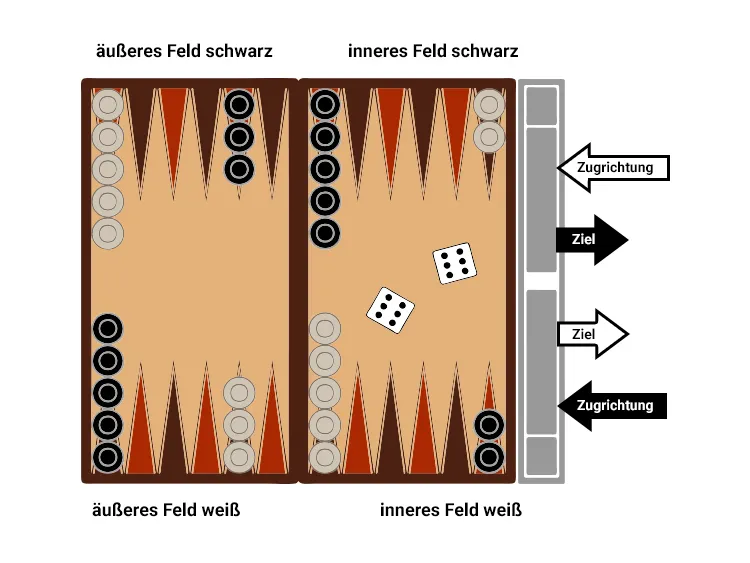
Arrangement of the stones: Backgammon setup and formation
You already have experience in playing Backgammon and want to play against real opponents online? You know the rules and are looking for equal opponents?
Play online backgammon against real opponents
- The game pieces are placed in their basic position as shown in the figure above.
- The direction of white’s move is in the direction of the inner white square 19-24 (numbered through from top right to bottom right).
- The moving direction of black is towards the black inner square 6 -1.
+24-23-22-21-20-19-+---+18-17-16-15-14-13-+
| X              O |   |    O           X |
| X              O |   |    O           X |
|                O |   |    O           X |
|                O |   |                X |
|                O |   |                X |
|                  |   |                  |
|                  |   |                  |
|                X |   |                O |
|                X |   |                O |
|                X |   |    X           O |
| O              X |   |    X           O |
| O              X |   |    X           O |
+-1--2--3--4--5--6-+---+-7--8--9-10-11-12-+
Standard starting position in notation: X = dark checkers (points 24/13/8/6), O = light checkers (points 19/17/12/1).
Backgammon rules and game target
After the Tavla or Backgammon set up, the moves are determined by the number of two dice rolled. Each player endeavours to gather all his 15 checkers in his own field, also known as home field, after the tops of the board have circled, in order to then bear them off the board. White from your own inner field with points 19-24 out, black from your own inner field with points 6-1 out. The first player to do so wins. There are different methods and tactics to prevent the opponent from reaching the goal.
Tavli vs Backgammon Rules
The rules of a normal backgammon game are very different despite the same line-up with Tavli. For example, Tavli has 3 rounds which contain different rules: Portes, Placato and Fevga Portes is the round that has the most similarities with backgammon, with the following differences:
- There is no doubling cube (64 cube)
- There is no backgammon (3 points), but one point for an easy win and two points if the opponent still has all his checkers on the board
- Instead of moving the first move with the initial roll, which determines the starting player, Tavli rolls the dice again
Backgammon set up & playing equipment
To start and set up a backgammon game you need a board, for example in a backgammon case, fifteen light and fifteen dark pieces (blots), two pairs of dice and a doubling cube. The arrangement, formation, or structure of Backgammon is as follows in the basic formation/starting formation:
Backgammon setup and starting line-up
The doubling cube/doubling cube is used to double the stake during the backgammon game. The numbers on this cube show the possibility of increasing the stake from 2-fold to 64-fold. If there are two dice and no backgammon case, it is also possible to print out a field and the checkers and to make the field yourself (DIY backgammon). Backgammon cases can be ordered online at a reasonable price.
You want to use the doubling cube once against real opponents for backgammon for money? You have the opportunity to do so in online platforms for playing backgammon.
Register now online for Backgammon and play against real opponents
The doubling cube – how it works

doubling cube
The offer to double may be made by the player whose turn it is to roll the dice. The stake is doubled – if you play for points you can do so until the maximum number of points is reached. As a rule, players should only use the doubling cube if they are aware of their own chances at the time of the offer – for example, if they expect to win the game. To maximize the chance of the opposing player accepting the offer, however, the odds distribution must not be too extreme.
Reject the doubling offer
If the offer is rejected, the opponent immediately loses the game and pays the existing stake at the time of the rejection. The game is over and a new game can begin. If you are in a position to accept the offer to double, you have to decide whether you can still win the game or what the chances are of losing the game.
Duplication offer acceptance
Assuming the doubling, it is your turn next when it comes to doubling. If the offer is accepted, the doubling cube (starting with the two) is placed on the bar as the score indicator. However, only the player who has accepted the previous one can make another offer to double. This position of power should always be kept in mind as a player, both as the player who initially plays the cube and as the player who accepts the offer. From the next move on, the player who accepted the doubling cube can play the cube again, as long as he considers the situation to be positive.
How to win in Backgammon, or how the game ended, can be read in the next section.
Score of the dice
A checker may be moved out if the point value of one die is sufficient to move that checker beyond the edge of the board. You may use part or all of a roll of the dice to move checkers further inside the board instead of bearing off. We explain the full bearing-off rules — including the special cases when you don’t have a checker on the rolled point — in detail in our article on bearing off.
If a roll is suitable to bear off a checker from a point that is not occupied, that roll must be used to move a checker from the highest occupied point. The player may choose which number he wants to move first.
By playing out the checkers, individual checkers can also stand without a block. If the opponent still has checkers that have been hit and must be played back into the game, this is a potential risk. If you want to avoid this situation, you should first move your own blots inwards as far as possible in your own field, if this is possible.
Backgammon setup and line-up
The structure of backgammon and the set-up or starting position of the board is relatively easy to explain:
- There are a total of 24 points (spikes), 12 white and 12 black points
- The 15 white and black checkers are positioned on the points
- The positioning depends on the direction of pull and the goal: Two points with 5 stones, one point with 3 stones and one point with 2 stones
- As a rule of thumb you can remember White outside, black inside and black inside, white outside – at the start there are 2 stones of your own colour in the outer field 3 stones
Once the blots or checkers have been placed on the board and the players are ready to start the game, each player rolls one die and the player with the higher number starts playing. If a double was rolled at the beginning, the dice are rolled again until one player has a higher number of points on a die. The backgammon set-up is now complete and the game can begin.

About the Author
Ulf Mayer
I love backgammon in all its forms – whether it's a quick match on my smartphone to pass the time, or a glass of wine alongside a beautiful wooden board with family and friends. As the founder of backgammon-meister.de, I share my passion, tactics, and tips to help both beginners and ambitious players dominate their next match. Dice cup ready? Let's master the game!
backgammon-meister.de has been online since 2008.